The Oregon Water Resources Department in coordination with the Basin Advisory Committee, Washington Department of Ecology, and the Confederated Tribes of the Umatilla Indian Reservation have developed a project overview survey to begin archiving the extensive work that has started in the basin.
Information shared in this survey will help us highlight our progress together. This survey is intended for projects that have already been started or are already completed, information on planned projects should not be shared on this form. This survey contains 25 questions and is expected to take less than 15 minutes to complete for each project. Data collected in this survey will be used for informational purposes only and will be incorporated into communications materials, strategy reports, and other engagement materials to highlight Basin Projects.

The Walla Walla Water 2050 Strategic Plan was developed as a package of strategies that integrates environmental and community benefits to achieve a shared vision. The vision includes improving instream flows, restoring floodplains, and managing water resources for aquatic life and communities of the Walla Walla River Basin.
Local community members and regional governments worked together to create the strategies. While there is a long history of planning and environmental improvement projects aimed at improving water quality and addressing water supply issues in the basin, its health and productivity are constrained by:
Low streamflows compounded by irrigation diversions.
Concrete and/or incised stream channels, levees, weirs, and other alterations.
Point-source and non-point-source pollution.
Declining water levels in the alluvial and basalt aquifers.
Increased stream temperatures and degraded habitat for fish and other species.
Climate change driving drastic changes in temperature and habitats.
Over-allocated water supply for out of stream uses.
Historic loss of fisheries production (salmonids)
Key to enacting water change in the basin is the over-arching commitment of the governments involved, which include the states of Oregon, Washington, and the Confederated Tribes of the Umatilla Indian Reservation (CTUIR). Navigating the regulatory frameworks of the two states and respecting the sovereign rights of the Tribes is a crucial component for success. As the states develop a shared framework, the local community’s feedback and support has also been key for achieving historic legislation that allows for new water management tools to be used in the basin.

Strategies are grouped into three tiers with Tier 1 being the highest priority and Tier 3 being the relatively lowest priority. These tiers were used to help illuminate priorities, given that strategies will compete for time and resources in the short-term. However, strategies in Tier 3 are not considered “low priority” and should still be considered important components of the overall package of strategies. Through a collaborative community process, 60 actions were identified across six focus categories. These actions were then sorted into three Tiers. Twenty-three (23) actions were identified by the process as Tier 1 and are summarized below.
An explicit goal of the planning process was to generate strategies that, when fully implemented, meet multiple water resource benefits. The community identified strategies for floodplains and habitat, water quality, water supply and efficiency, and monitoring and metering. These strategies were then evaluated by the following attributes:
Implementation tool: type of action required to implement the strategy.
Implementation timeline: when the bulk of the strategy could be funded and/or implemented.
Cost: estimated cost of implementation.
Ease of implementation: relative feasibility of implementation.
Over the next 30 years, the community is committed to employing this integrated water resource management approach. By integrating the goals and solutions from the basin’s diverse stakeholders in both Oregon and Washington we’re confident the Walla Walla basin will achieve holistic and viable long-term solutions for sustainable water use in the basin.

As the demand for water increases and supplies dwindle in the Walla Walla River Basin, the Washington Department of Ecology, Oregon Water Resources Department, and the Confederated Tribes of the Umatilla Indian Reservation are working with stakeholders on both sides of the state border to find solutions.
With the passing of Second Substitute HB 1322 in the Washington State Legislature in 2023, Ecology was given authority to enroll water rights from Oregon into Washington’s Trust Water Right Program. RCW 90.90.120 authorizes Ecology to develop new water supply projects throughout the Walla Walla basin, including in Oregon. Projects implemented to create developed water supplies are referred to as “developed water projects.” A developed water supply project must contribute to one or more recommended strategies identified in the Walla Walla 2050 Water Plan and result in an increase in water supply for a defined period of time (https://apps.ecology.wa.gov/publications/documents/2511103.pdf).
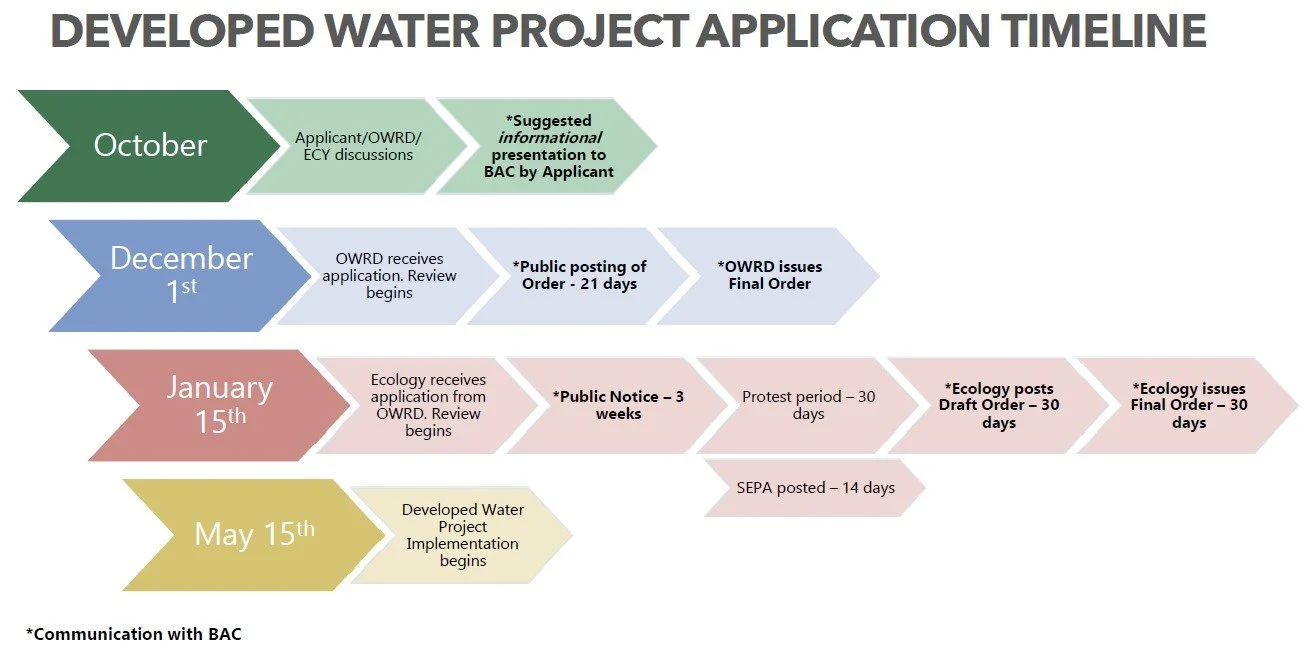
Developed water project applicants should engage with OWRD and Ecology on project details prior to submitting applications. In addition to agency engagement, it is highly recommended that applicants present project details to the BAC or Implementation Workgroup. To ensure that both states can process applications and implement projects effectively, applicants should submit developed water project proposals to OWRD by December 1st. Both OWRD and Ecology will provide opportunities for public comment, including notice posted through traditional and online media resources as well as email notification to all relevant state and federal agencies, potentially affected local governments, federally-recognized Tribal governments, and subscribers to relevant Ecology and OWRD subscriber lists.